

-
 Find Relief. Feel Better.Start with a FREE TMS INFO CALLCheck My Eligibility
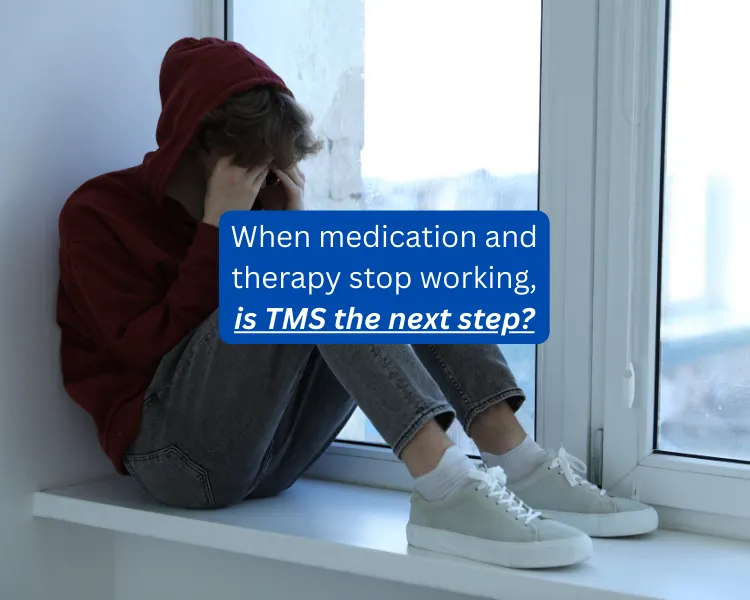
Patients who reach the point of considering TMS therapy in Philadelphia are usually not exploring depression treatment for the first time. They have lived through medication trials, therapy courses, or both, and are now confronting a narrower, more demanding question. The question is not whether antidepressants or therapy work in general, but when those approaches stop being sufficient and a different level of intervention becomes appropriate. TMS becomes clinically appropriate when medication and therapy have reached their effective limits, and determining that point requires professional evaluation rather than comparison alone
Decisions about depression treatment often fail when different options are treated as interchangeable. Medication, therapy, and TMS are not substitutes for one another. They intervene at different levels of depressive illness, and that distinction shapes when one option becomes more appropriate than another.
Medication acts broadly across neurochemical systems. That systemic reach can be effective for many patients. Still, it also means that benefits and side effects are inseparable, and responses are influenced by factors such as metabolism, genetics, and prior exposure. Therapy intervenes through cognition, behavior, and emotional processing, which can be powerful when depression is maintained by patterns that can be consciously modified. TMS operates at a different level entirely, targeting specific brain circuits involved in mood regulation rather than altering the entire system.
This difference explains why some patients experience diminishing returns from repeated medication trials or long courses of therapy. It also explains why TMS is not a replacement for earlier treatments, but a shift in how the illness is addressed.
Once the level of intervention is clear, the next determinant is how treatment unfolds over time and what it demands from the patient. These are not lifestyle preferences. They are clinical constraints that influence outcomes.
Medication requires patience and tolerance for uncertainty. Symptom relief often lags behind side effects, and adjustments can extend instability. Therapy progresses according to engagement, insight, and the ability to practice skills consistently, which becomes more difficult as depression deepens. Improvement may be meaningful but uneven, particularly when energy and motivation are limited.
TMS therapy follows a different structure. The commitment is concentrated into a defined period, with weekday sessions and a clear endpoint. Many patients notice changes earlier in the course, which can be stabilizing for those who have struggled with long, open-ended treatment timelines.
| Treatment Approach | Typical Response Pattern | Participation Demand | Course Structure |
| Antidepressants | Gradual, variable | Daily adherence | Ongoing |
| Psychotherapy | Incremental, skill-based | Weekly sessions plus practice | Extended |
| TMS therapy | Earlier change for many | Daily weekday visits | Finite |
These differences often determine whether a treatment is realistically sustainable, not just theoretically appropriate.
Treatment decisions are frequently driven by tolerability rather than efficacy. Side effects, emotional burden, and cumulative strain often determine whether a plan can be followed long enough to help.
Medication side effects are systemic and persistent for as long as the drug is taken. Sexual dysfunction, weight change, sleep disruption, and emotional blunting are common reasons patients discontinue or rotate medications. Adjustments frequently require tapering, which can prolong instability and discourage continuation.
Therapy introduces a different burden. Emotional discomfort, activation of distressing material, and sustained effort are inherent to the process. These effects are expected and manageable, but they require capacity that is not always available at later stages of illness.
TMS side effects are typically localized and time-limited. Scalp discomfort, headaches, or fatigue may occur early in treatment but often diminish over time. For patients who have struggled with systemic side effects, this distinction becomes central when evaluating whether TMS therapy in Philadelphia is appropriate.
Most patients considering TMS are already receiving some form of care. The clinical challenge is not whether treatments can coexist, but whether they are coordinated in a way that preserves clarity and direction.
TMS is commonly provided while patients remain on antidepressants. This continuity can be appropriate, but medication stability matters. When doses change mid-course, it becomes difficult to interpret whether improvement or worsening reflects neuromodulation, pharmacologic adjustment, or interaction between the two.
Therapy can meaningfully support TMS when roles are clearly defined. As mood and energy shift, therapy can help translate physiological change into functional improvement. Without structure, therapy may lag or misinterpret short-term fluctuations as failure rather than transition.
Effective combination care is intentional. Each modality has a defined role, and changes are made deliberately rather than reactively.

One of the most common reasons patients abandon effective treatment is misreading early progress. Depression does not improve in a straight line, and narrow evaluation often leads to premature conclusions.
Evaluating these domains together allows clinicians to distinguish transient reactions from meaningful responses. This approach reinforces why interpretation matters as much as intervention when deciding whether to continue, adjust, or escalate care.
Financial planning is part of responsible decision-making, but cost cannot be evaluated without context. Antidepressants often appear inexpensive month to month but represent an ongoing commitment. Therapy costs accumulate gradually and vary based on frequency and network status.
Many patients ask, "What is the cost for TMS Philadelphia?" The answer depends on insurance coverage criteria, deductible structure, and documented treatment history, rather than a flat fee. TMS therapy in Philadelphia is frequently covered under defined conditions, which require individualized verification before planning can proceed.
Evaluating cost without considering the likelihood of response or durability often leads to repeated transitions rather than resolution.
TMS is not selected because it is newer or more intensive. It becomes relevant when history indicates that earlier levels of intervention have reached their limit.
Patterns that often prompt evaluation include partial response to multiple medications, inability to tolerate systemic side effects, or stalled progress despite sustained engagement in therapy. Certain clinical factors require careful assessment before proceeding, including seizure history or bipolar spectrum features. These considerations guide planning rather than exclusion.
Self-selection based on category descriptions rarely succeeds because it overlooks interactions among biology, behavior, and treatment history.

Understanding differences between treatment options is necessary, but it does not determine fit on its own. Depression presents differently across individuals, and response patterns emerge from interactions that checklists or comparisons cannot capture.
At Spark TMS, the role is to determine when TMS therapy in Philadelphia makes sense relative to medication and other treatments, given a patient's history, tolerance, and constraints. The objective is alignment rather than escalation, and coordination rather than accumulation. Structured evaluation replaces trial-and-error with deliberate planning.
A consultation provides that structure and supports decisions that are clinically grounded rather than reactive.
Understanding when TMS therapy in Philadelphia is appropriate compared to medication and therapy requires professional interpretation. A free consultation with Spark TMS allows for a structured review of history, goals, and constraints to determine whether TMS fits now, later, or not at all, and how it should be integrated into a coordinated treatment plan.