

-
 Find Relief. Feel Better.Start with a FREE TMS INFO CALLCheck My Eligibility
For many patients we see at Spark TMS, the decision to try Transcranial Magnetic Stimulation (TMS) follows years of medication trials that offered limited relief. As you evaluate providers for TMS Philadelphia, you may be familiar with the systemic side effects of antidepressants, such as weight gain, fatigue, or emotional blunting. Considering a new treatment often brings a protective instinct: you want to know exactly what physical risks you are accepting before you sit in the chair.
Because TMS uses magnetic pulses rather than blood-circulating chemicals, its safety profile is fundamentally different from other forms of depression therapy Philadelphia offers. The side effects are localized, mechanical, and typically transient. Understanding this distinction is vital for accurate informed consent. By examining the physiological mechanisms behind the treatment, from the sensation of scalp tapping to the rare risk of seizure, we can separate valid medical precautions from unnecessary fear, allowing you to weigh the evidence with confidence.
To understand the side effects, you must understand the physics of the treatment. TMS is a medical procedure based on electromagnetic induction, in which a treatment coil is placed against the head and generates rapid magnetic pulses.
These pulses pass easily through the skull to stimulate neurons in the brain, typically targeting the dorsolateral prefrontal cortex. However, the magnetic field creates a small area of influence around the target that affects the head's physical structures.
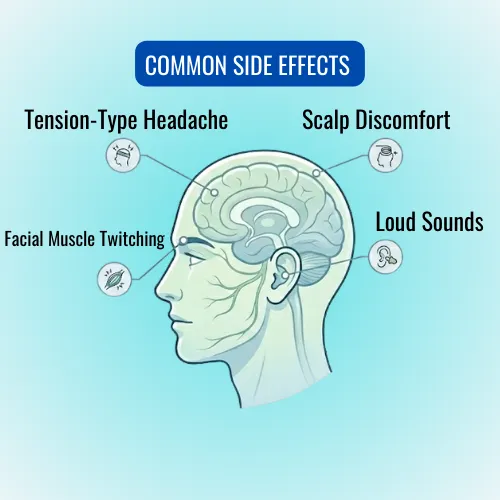
First, the magnetic pulses can stimulate the superficial muscles and nerve endings in your scalp and forehead. This direct stimulation causes a rapid-twitching or tapping sensation during treatment, as noted by the National Institute of Mental Health. Second, the coil emits a loud "click" with every pulse as the magnetic energy mechanically expands and contracts the coil itself.
This mechanism explains why physical sensations occur even though the brain itself has no pain receptors. For example, if your eye or jaw twitches during treatment, it is not a sign of damage or error. It is simply a facial muscle reacting to the magnetic pulse, physiologically identical to a doctor tapping your knee to check a reflex.
When clinical literature describes side effects as "common," it is not using the term alarmingly. In this context, it refers to effects that are frequently reported in trials but are generally temporary, manageable, and directly tied to time spent in the chair.
Headache is the most frequently reported side effect, affecting roughly 1 in 5 patients. This is not typically a migraine or neurological headache. Rather, it is a tension headache caused by the sustained contraction of scalp muscles during the 20-minute session.
A 2022 systematic review and meta-analysis of 53 randomized sham-controlled trials involving 3,273 participants confirmed this frequency. The study found that headaches occurred in 22.6% of patients receiving active TMS, compared to 16.2% in the sham (placebo) group.
These headaches tend to be most prominent during the first week of treatment as your body adjusts to the sensation. At Spark TMS, we manage this proactively:
Because the coil sits directly on the skin, some sensitivity at the contact point is expected. The same 2022 meta-analysis separates "discomfort" from actual "pain" to be precise, noting that 10.9% of patients reported general discomfort, while 23.8% reported pain at the stimulation site (compared to significantly lower rates in sham groups).
However, this sensation rarely lasts for the full course of treatment due to a biological phenomenon called habituation. Just as you eventually stop noticing a wristwatch on your arm, your scalp nerves become less sensitive to the tapping over time. If the pain is sharp rather than dull, it usually indicates the coil is resting on a specific nerve ending. Telling your Spark TMS operator immediately allows them to make minor adjustments to the coil's pitch or rotation, often eliminating the "hot spot" instantly.
The Mayo Clinic notes that tingling, spasms, or facial muscle twitching are common side effects. This occurs because the magnetic field can stimulate branches of the trigeminal nerve, which controls facial sensation and movement. You may feel your eyebrow or jaw twitch in rhythm with the machine's clicking sound.
While this sensation can be annoying or surprising, it is entirely benign. The most important thing to remember is that the twitching stops the instant the pulse stops; it does not continue after the session ends. If the twitching is too distracting, your provider can often adjust the coil placement by just a few millimeters to move away from the nerve branch.
To help you visualize the safety profile, the table below categorizes the most-discussed side effects by frequency and typical clinical management.
Side Effect |
Frequency |
Typical Management Strategy |
Tension Headache |
Common |
OTC pain relievers; adjusting ramp-up speed |
Scalp Discomfort |
Common |
Habituation (improves over time); coil adjustment |
Facial Twitching |
Common |
Coil repositioning; stops immediately after pulse |
Lightheadedness |
Less Common |
Hydration; pausing treatment; standing slowly |
Auditory Issues |
Preventable |
Mandatory foam earplugs during every session |
Seizure |
Rare (<0.1%) |
Pre-screening; safety protocols; medical intake |
Knowing the risks is half the battle; preventing them is the other half. At Spark TMS, our mitigation strategy involves specific clinical standards designed to minimize these side effects.
While most patients complete treatment with only minor annoyance, you should contact our office immediately if you experience specific symptoms that fall outside the norm.
Call us if you experience a sudden, severe headache that feels different from a typical tension headache, or if you have any confusion or difficulty speaking after a session. You should also report any fainting episodes, changes in your hearing, or new symptoms of mania, such as euphoria and racing thoughts.
If you are experiencing a mental health emergency or thoughts of self-harm, please call 988 or go to your nearest emergency room immediately.