

-
 Find Relief. Feel Better.Start with a FREE TMS INFO CALLCheck My Eligibility
Research published in early 2026 has fundamentally altered the landscape of mental health treatment. Two pivotal studies have moved the field past the simple question of "does TMS work?" The first was a large-scale randomized controlled trial in World Psychiatry, and the second was an economic evaluation in BMJ Mental Health. Together, they force us to ask a more complex and urgent question: "How fast, how precise, and how efficient can this treatment be?"
This shift is not merely academic. It signals a structural change in how we treat Treatment-Resistant Depression (TRD). The focus has moved away from standardized protocols. Instead, the field is moving toward accelerated, connectivity-informed delivery models. These new models prioritize specific brain network engagement over simple anatomical targeting.
To understand why this moment is different from previous years of research, we must look at the fundamental structure of how we treat the brain. For years, Transcranial Magnetic Stimulation (TMS) was defined by a single, rigid standard. This usually meant daily sessions for 6 weeks, targeting a general region of the prefrontal cortex. While effective for many, this "one-size-fits-all" approach left questions about efficiency and precision unanswered.
At Spark TMS, we have monitored the evolution of neuromodulation since the very beginning. Our clinical roots go back to the original FDA-pivotal trials in 2004 at the University of Pennsylvania. We understand that "off-label" physician-directed applications are often where the most life-changing breakthroughs happen, provided they are based on scientific rationale and medical evidence.
The updates from 2026 challenge the foundational assumptions of the last decade. Previously, the six-week timeline was viewed as a biological necessity for neuroplasticity. New data suggests we can significantly compress the therapeutic timeline without sacrificing safety. This is achieved through higher daily doses and precise targeting.
Furthermore, the integration of biomarkers has transitioned from theoretical research to potential clinical utility. Specifically, we now have evidence that EEG readings can help predict who will respond to accelerated protocols. This marks the beginning of "precision TMS." In this new era, treatment is not just delivered. It is engineered for the individual's specific neural architecture.
But theoretical precision is only valuable if it can be executed in a real-world setting. To see whether this structural shift actually holds up under scrutiny, we must examine the specific methodology of the landmark trial that tested it.
In February 2026, World Psychiatry published the results of a double-blind, randomized, sham-controlled trial of Stanford Neuromodulation Therapy (SNT). This trial was designed to replicate earlier pilot findings in a larger, more rigorous sample.
So, when you combine extreme acceleration with MRI-guided precision, what happens? The data shows that changing the how of TMS dramatically changes the what of the results.
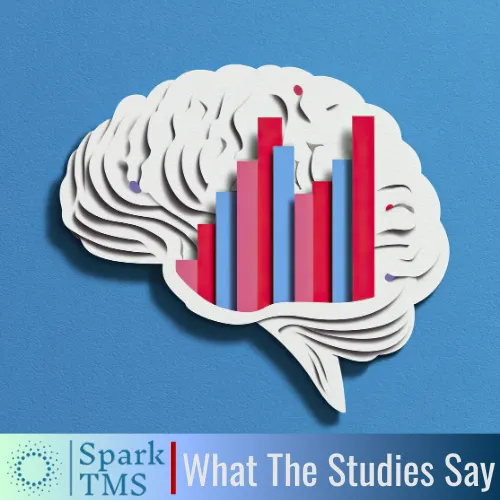
The results were statistically significant and clinically meaningful. At the one-month mark, 50.0% of the active treatment group achieved remission, compared to only 20.8% of the sham group. Response rates were similarly distinct. The study showed a 54.2% response rate for active treatment versus 25.0% for sham.
Critically, the study utilized EEG to understand why this worked. It found that active SNT significantly reduced "frontal beta power," a neural activity range in the 13–30Hz range. This reduction was not random. Greater drops in beta power in the Left Anterior Cingulate Cortex (L-ACC) correlated directly with greater symptom improvement.
This confirms that accelerated TMS is not just a "faster" version of the old therapy. It is biologically active. It engages deep-brain networks, such as the ACC, in a way that can be measured and tracked.
While these results are robust, they do not present a "cure-all."
However, biological efficacy is only half the equation. The most effective treatment in the world is of little use if it cannot be delivered sustainably in a clinical setting. This is where the second major finding of 2026 comes into play.
This intersection of cutting-edge speed and necessary infrastructure is exactly where Spark TMS lives. We don't just read these papers. We built our practice to be ready for them.
The convergence of these 2026 datasets changes the checklist for anyone considering treatment. We now have high efficacy from combined acceleration and targeting, with validation of new delivery models.
At Spark TMS, we were founded in 2018 specifically to bridge the gap between emerging academic research and patient care. Our clinical leadership has been involved in this field since 2004. We worked on the very trials that led to the original FDA clearance of TMS. We understand that breakthroughs often occur in off-label applications supported by sound evidence. This new research validates the approach we have always taken. It confirms that depression is a network issue, not just a chemical one.
The research of 2026 has provided the signal the field was waiting for. We now know that remission can be achieved in days rather than weeks. We know that specific neural markers can predict success. And we know that efficient delivery models are essential.
But data on a page is different from the reality of living with depression. We know the weight you are carrying. We also know that navigating these new options can feel overwhelming. You do not have to figure this out alone. The most meaningful decision is no longer just whether to try TMS, but how it is evaluated, targeted, and delivered for you.
Let's discuss what these new findings mean for your specific situation.